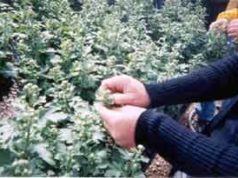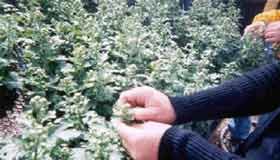

Tuberose commonly known as Rajni gandha. It produces waxy, white and fragrant flowers on long spikes, which are mostly used as cut flowers; for making garlands and extracting essential oil. In this article, we will talk about tuberose cultivation.
If you are looking for Tuberose flower bulbs you can buy Tuberose from here
Tuberose cultivation is getting popular in North India where it blooms during July-Oct. This period is devoid of cut flowers.
1. Climate for Tuberose Cultivation
Tuberose grows well in sunny situations. In India, commercial tuberose cultivation is just confined to warm, humid areas with average temperature ranges from 20-350C.
2. Soil Preparation for Tuberose Cultivation
Loam and sandy loam soil having pH range from 6.5-7.5 with good aeration and well drained soils are considered suitable for its cultivation.
The field should be well prepared by giving 2-3 ploughings and incorporating 25-30 tones/ha of well rotten FYM before planting time.
Suggested Reading: Gerbera Cultivation
3. Tuberose (Rajni Gandha) Varieties
Calcuttia Single
Form and Colour: White flower, with petals in a single whorl
Brief description: Single flowers, six petals, scented. About 40 flowers are borne on spikes of length 60 cm
Uses: Cut flower and loose flowers
Calcuttia Double
Form and Colour: White flowering with a pink tinge and petals in two whorls
Brief description: Four whorls of petals not scented. Longer spikes (80 cm) bears only 35 flowers
Salient remarks: Good performance under Jammu condition
Suvasini
Form and Colour: White flowers, with petals in two whorls
Brief description: Double, four whorls of petals, scented. Shorter spikes (50 cm) bearing about 30 flowers /spikes
Salient remarks: Good performance under Jammu conditions
Sringar
Form and Colour: White flowers, with petals in a single whorl
Brief description: Single, six petals, slightly scented, shorter spikes (40 cm) bears about 40 flowers
Salient remarks: Good performance under Jammu condition
4. Tuberose Planting Time : March –April
5. Spacing for Effective Tuberose Cultivation :
Intensive cultivation: 20 cm x 20 cm
Ordinary condition : 40 cm x 40 cm
6. Sowing Depth: 5-7cm deep
7. Manuring:
| FYM | N | P2O5 | K2O |
| 5 kg | 30g | 20g | 10g (per sq. mt.) |
| 25 q | 15kg | 10kg | 5kg (per kanal) |
| 50 ton | 300kg | 200kg | 100kg (per ha.) |
Apply ½ N, 30 g P2O5 and 10 g K2O at the time of planting and another ½ dose of N at the time of spike emergence.
8. Tuberose Propagation
Tuberose is propagated by bulblets. Treat the bulblets with Bavistin (0.1%) for 30 minutes before planting in the field. Bulb weighing about 40-50 g is suitable for planting.
9. Irrigation for Tuberose Cultivation
Tuberose (Rajni Gandha) plantation requires sufficient soil moisture for its growth and flower production. The weekly irrigation is required during April-June whereas during Oct – March irrigation at the interval of 15 days is sufficient to meet its requirement.
Looking for Tuberose flower bulbs? Buy Tuberose from here
10. Seed rate
7500 to 8000 bulbs/ Kanal or 1, 50,000 to 1, 60,000 bulbs/ha
11. Earthing Up
Tuberose plants should be earthed up when they attain a height of 30 cm and process is repeated after 2-3 weeks to get a final height of 15 cm of the soil.
12. Interculture
Weeding can be done by two ways
a) Hand weeding – Once in fortnight
b) Weedicide spray – i) Pre-emergence – Atrazine @ 1-2 kg/ha
ii) Post emergence – Paraquat @ 1-5 kg/ha
13. Tuberose Harvesting
a) Loose flowers – Individual flowers picked when they are fully opened
b) Spikes – When lower pair of flowers is fully opened
14. Vase Life
Tuberose is sensitive to the stresses of storage and transportation. Pulsing treatment with 8% sucrose+8-HQC 200 ppm for 24 hours promoted floret opening, the reduced floret abscission and extended the vase life. Spikes dry stored at 7oC for 24 hours extended the vase life by 2 days.
15. Tuberose Packaging
The spikes of Tuberose are tied in bundles of about 100 spikes, wrapped in wet newspaper sheet and finally packed in cartoons. Pack loose flowers in baskets.
16. Yield
Cut flowers – bout 9,000 spikes/Kanal
Tubers – About 80,000 bulblets/Kana
17. Bulb Production
Optimum bulb weight for planting is 40 – 50 g. One bulb produces 10-12 bulblets of this size in two years.
These should be dug in the month of Feb- March when the leaves become dry and replanted within 15-20 days of digging. Treat the tuber with 0.1% Bavistin for 30 minutes before storage.
If you are looking for Tuberose flower bulbs you can buy Tuberose from here
Contributed By:
Dr. R. K. Pandey, SKUAST-Jammu