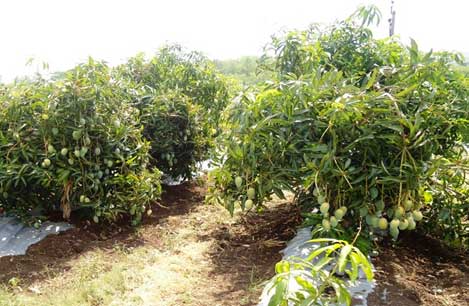
In this Article we will discuss Mango Cultivation in Ultra High Density Mango Plantation
Mango occupied a pre-eminent place amongst the fruit crops grown in India because of its great utility. Mango exhibits a wide variation in flowering and fruiting habit due to varietal differences and diversity in agro-climatic conditions. India produces world’s largest tonnage of mango.
India is the largest producer of mango but the productivity is very low. Low productivity in mango cultivation is mainly due to low plant population per hectare, absence of scientific methods of irrigation, inefficient nutrient management, improper orchard management practices and losses due to pests and diseases.
Mango, so far has been grown either this as a crop with least management efforts and without inputs like irrigation, fertigation etc. And it leads to low productivity in mango. Now it is important to increase the production of mango by adopting the new hi-technology.
Pro Tip:Looking for Start your Own Garden Guide? Try this guide with 51 varieties of seeds
We need a technology, which gives more production per unit area, for which the theme Ultra-high density planting comes to fore front. Mango cultivation can be revolutionized by the adoption of ultra high density planting system.
This planting system heralds a new era where mango becomes quick, high, shrinking land availability.
Mango tree is believed to have evolved as a canopy layer species in the tropical rainforest of south and south-east Asia. Mature specimens can attain a height of 30 cm and can survive for more than 100 years.
The root system consist of long, vigorous taproot and abundant surface feeder roots. Both male and perfect flowers are found within a single inflorescence. The flowers are cross pollinated by flies and honey bees.
Bonus: Watch Video – High Density Planting in Fruits
Cultivation practices for Ultra High Density Mango Plantation
Lets talk about the cultivation practices for Ultra High Density mango plantation.
Mango can be grown in a wide range of soils except clayey or extremely sandy or rocky calcareous, alkaline or water logged soils. It prefers a soil pH 6.5 to 7.5. Under UHDP, Mango is planted at 3×2 m which accommodates 674 plants per acre.
Pit should be marked at 3×2 m before pit digging and pits of 1×1×1m are to be dug at marked places.
Alternatively one meter deep and one meter deep and one meter wide trench can be prepared at every three mater. The pits should be allowed to weather for some weeks before filling media.
The media consist of 40-50 kg soil, 0.5 -1.0 kg SSP, 0.25 kg neem cake, 20 kg compost, and 10-15 g of Thimet. Plantation is to be raised by using grafted sapling. Epicotyl grafting is recommended for UHDP as the training of the tree starts at a very early stage itself.
The bamboo support essential to newly planted grafts. The critical components of UHDP technology are the management of inputs: irrigation and fertilizer and besides the canopy management. These two inputs are provided through drip irrigation systems.
Table No. 1: Mango varieties suitable for Ultra High Density Plantation
The below table shows various varieties of mango which you can consider for Ultra High Density Plantation.
State
Varieties
Andhra Pradesh
Alphonso, Alampur, Baneshan, Totapuri
Bihar
Bombai, Himsagar, Langra, Chausa
Goa
Mankaurad
Gujarat
Alphonso, Kesar
Karnataka
Alphonso, Bangalora, Neelum, Mallika
Tamil Nadu
Alphonso, Banganapalli, Neelum
Uttar Pradesh
Bombay green, Dashehari, Langra,
Maharashtra
Alphonso, Kesar, Ratna
Application of fertilizer in Ultra High Density Planting in Mango
The recommended fertilizer dose for Ultra High Density Plantation of Mango in soil having medium nutrient content is given below.
Table No. 2: Fertigation schedule and quantity (Kg/Dose/Year)
Age
Month
Number of doses
Urea
H3PO4
MOP
MgSO4
1 year
July- Sept
12
1.4
0.5
0.8
0.000
Jan – May
20
1.7
0.6
0.9
0.000
2nd year
July- Sept
12
2.7
1.2
2.3
0.278
Jan – May
20
1.7
0.7
1.4
0.167
3rd year
June- Aug
12
1.4
1.2
1.5
0.000
Jan- May
4
3.2
1.2
4.6
0.333
Training and pruning
When the plant height reaches 45-60cm, the terminal bud should be pinched at 5-6cm below the apex to encourage growth of auxiliary bud. Pruning is very essential and critical operation of UHDP to maintain fruiting shoots and to contain canopy.
Pruning must be done as soon as after harvest preferably before 15th June in central and southern India. Tertiary branches have to be headed back in such way that the plant height can be maintained at 1.5 m and having 10-15 tertiary shoots.
Cut ends needs to be applied with Bordeaux paste or 2 % copper oxychloride (COC) suspension. About one month after pruning, thinning of newly emerged shoots is essential to avoid excess shoots and overcrowding.
To know more about high density planting in mango, you can also Watch the high density mango plantation video.
Benefits of Ultra High Density Plantation in mango
Increases productivity up to 2-3 times
Reduces water used for irrigation up to 50 %
Increases fertilizer uptake by plants when fertigation is practised.
Challenges of UHDP mango plantation
Despite its benefits, UHDP mango plantation also faces several challenges, including:
High initial investment: UHDP mango plantation requires a high initial investment as it requires high-density planting, advanced irrigation systems, and specialized machinery.
Maintenance: UHDP mango plantation requires regular maintenance and monitoring to ensure optimal growth and yield.
Pest and disease management: UHDP mango plantation is susceptible to pests and diseases, and farmers need to implement proper pest and disease management strategies.
Limited market: UHDP mangoes are a premium product and may have limited market demand. Farmers need to identify and target specific markets to sell their produce.
If you find this article interesting, you can get more knowledge from the book on Mango production from here
Contributed by:
Makhmale Sandip11Ph.D Scholar & Research Fellow at Jain Irrigation System Ltd
Department of Horticulture, Junagadh Agricultural University, Junagadh- 362001 (Gujarat)